Tuesday, 21 October 2014

How GeoWarehouse & ViMO Complement Each Other?


We have to preface this by saying that GeoWarehouse and ViMO are not one and the same. ViMO is not the app version of GeoWarehouse. Both offer completely different capabilities and are used different ways – however using ViMO, you can perform some of the same capabilities you do on GeoWarehouse.

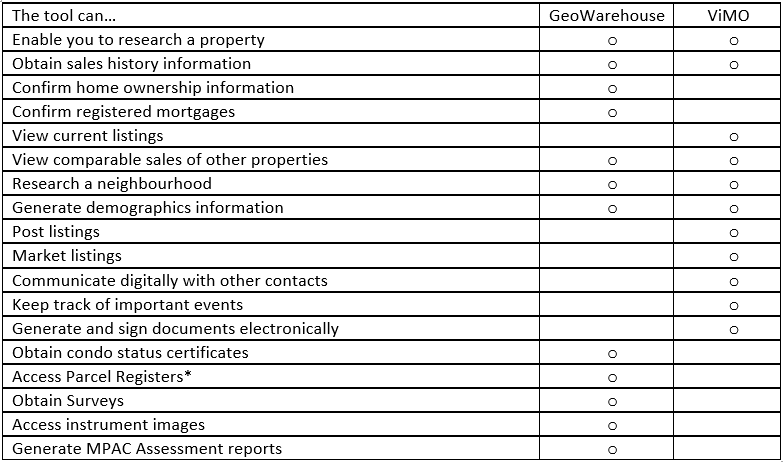
Here is a fun little table to help you understand some of the differences and nuances:
These don’t fully describe all the capabilities that GeoWarehouse and ViMO offer but are somewhat of a summary.  GeoWarehouse is a property search tool that supports your due diligence and ViMO is a tool to enhance your presentations and client experience while on the go. Both make you more agile and efficient. Used together GeoWarehouse and ViMO are the best toolset available on the market today for real estate sales professionals.

The beauty of mobile technology enables us to do so much more on the go. Now you have the opportunity to compliment what you have with GeoWarehouse by adding to the ViMO mobile app to your arsenal!

For more info about GW visit www.geowarehouse.ca.
For more info about ViMO visit www.myvimo.ca.

*An official product of the Ontario government pursuant to provincial land registration statutes.
 

Tuesday, 14 October 2014

Game: Crossword Puzzle – Online Real Estate Forms


Real estate forms can finally be signed electronically – a very important change for real estate professionals! This can mean so must time and cost savings-but do you know what forms can actually be signed electronically? We’ve got a game to help you find out! 

The following crossword puzzle highlights online real estate forms, many of which you can create and sign electronically in ViMO. Good luck! Check it out here: http://justcrosswords.com/Real_Estate_Forms_custom35293.html.  

Want more information about signing real estate forms electronically? Call GeoWarehouse today at 1-866-237-5937.

Monday, 6 October 2014

Who is the Legal Property Owner? Why Assuming Creates Problems


In real estate, you count on your clients to be forthcoming with information, but this doesn’t always end up being the reality of things. 

It seems that there are three different groups of people where non-disclosure is concerned: 

·        Those who innocently omit information because they forgot or didn’t think it was relevant. This can often occur when there is a parent or sibling on title, where the client is managing the transaction. This could be in the cases of spouses where one is acting with the consent of the other so didn’t think that they had to disclose the other person. The list can go on and on where innocent omissions are concerned.
·        Then you have those who are scheming for one reason or another. This can be the case in situations of separation and divorce or even where a dispute is taking place.
·        Finally you have the group that are out to commit outright real estate fraud. 

Generally speaking you are most likely to run into the first group, less likely to encounter the second group and hopefully, even less likely to encounter the last group. What is true of all 3 groups though is that a little bit of due diligence goes a long way with respect to taking on a new client – whether the client is a buyer or seller.                                 

Even if you meet with a potential customer, they impress you in an interview and you have little to no suspicion to believe that they have failed to disclose information – you still should do your due diligence! These days it is difficult to simply count on documents provided by your client validating that they are the owner. 

It is always advantageous to verify preliminary information first.
 
·        Interview the client: If a seller, directly ask if there is anyone else on title. When the client signs off on the agreement for you to represent them, take a copy of their ID at that point (rather than waiting until an offer has taken place).
·        After signing up with your client – perform your own search online to confirm that your client is the rightful property owner and that there are no other undisclosed parties on title.
·        Listing your client’s house for sale – now that you have performed your own search, you can feel confident with the information you are representing on your listing.
·        If another owner comes up, simply ask your client again. Once you know for a fact they will have to explain why. More often than not you will find out it was an innocent omission and the other party on title will sign your agreement.
·        If representing a buyer: once you have found a property that your client is interested in making an offer on, you can run a search to confirm the name of the seller(s)/current owner(s) and also any mortgages registered on title. This will help you to better understand the positioning of the seller.

Instead of making assumptions based on what the client or worse, another real estate sales professional, tells you, find out the information yourself. This will lead to more efficiency and cleaner closings.

Assuming can often lead to problems, so make sure that you are protecting yourself and your client. Find out more at www.geowarehouse.ca or call 1-866-237-5937.

Monday, 29 September 2014

Training: How to Generate a Property Details Report


The Property Details Report in GeoWarehouse is a must have document that outlines what you need to know about a property when representing a buyer or seller.

Information included in the Property Details Report includes:  

·        The real estate sales professional’s branding
·        The property address
·        The legal description and property identification number (PIN)
·        Aerial and street view of the subject property
·        Tax assessment information
·        Sales history on the property in question and more…


As this is a training video – we flash back to our training video


For more information about GeoWarehouse or for other training materials please visit www.geowarehouse.ca or call 1-866-237-5937.
Monday, 22 September 2014

Condo Status Certificate and Why You Should Get One on Any Condo Deal


Depending on whether or not you deal in condos – if you plan to, it is important to understand what a Condo Certificate is and why it makes sense as a real estate sales professional to obtain one directly when working on a condo deal.
 
The condo status certificate is a mammoth-sized legal document. Real estate lawyers will always request one on closing but it pays for the real estate sales professional to request one ahead of time to identify any problematic information and to provide the client with even more information about the condo they are purchasing. The condo certificate provides important information about:

·        The financial status of the condo corporation that is administering and maintaining the code – if the condo corporation is in financial trouble you may want to consider what this means for your client moving forward.
·        The financial status as it relates to the particular unit. This should include the amount of condo fee payments, the status of payments, indicate any arrears – your client will have to clear up any arrears in condo payments or liens that have arisen as a result of unpaid condo payments.
·        Monthly fees
·        Any large increases in fees that are planned to come into effect or are even being considered for that matter.
·        Arrears on any particular units. 

It also includes the condo declaration, by-laws, budget, reserve fund, insurance, management contract, rules, minutes of last general meeting, disclosure of law suits, disclose rules such as what pets/animals you can have, rules about use and declaration of external parts of your property like balcony or patio, etc…

There are two ways to obtain a condo status certificate:

Mail - It may be requested in writing to the management company. They may take up to 10 days to produce the condo certificate. You will likely have to pay the standard fee of $100.00 plus HST plus postage for the condo certificate. Generally speaking the fee is paid up-front when the written request is made. Many management companies are not equipped to take electronic payment so you will have to ship over a cheque.

Online - If you are a GeoWarehouse customer and a condo status certificate is available on a property that you search, it can be purchased through the GeoWarehouse Store. You will then receive the condo status certificate electronically which is faster and more efficient than mailing the request and payment – oh yes, and with the online option you can pay for the certificate in the GeoWarehouse Store by credit card.

Either way – once the offer has been made and accepted, you may want to consider getting a condo certificate right away. Also, some real estate sales professionals have reported requiring a review of a clean condo certificate as a condition in the offer. In this case timing is even more important. Once you have had a chance to review the condo certificate you can give your clients the thumbs up that there are no issues with their deal. Alternately, if representing a condo seller, having the condo certificate is a value add because you can show that the condo has a good corporation, a solid management company, and that the unit being sold is in good financial standing.

Don’t get stuck with a bad deal because a condo status certificate, ordered later rather than sooner, showed some questionable findings. Check out GeoWarehouse today to order yours online: www.geowarehouse.ca.

Monday, 15 September 2014

What’s on Title? What You MUST Know as a Real Estate Sales Professional


What does “what’s on title” mean to you? It could mean who is on title, it could mean what is owed against the title, or it could mean many other things. As a real estate sales professional it is important to perform due diligence to ensure that you have the complete and accurate picture as it relates to your client and the property being purchased or sold.

When representing a buyer or seller there are a couple of fundamental things that you will want to know and verify. 

Commission is almost always paid by the seller. The seller may or may not be your client. Whether you represent the seller or a buyer looking to purchase a property, where the seller is represented by a different agent you will want to validate some details: 

Who owns the home? You will want to double check that all homeowners are listed on the deal and none have been omitted. If the seller is your client you will want to verify that all people who are listed on title have signed on as your clients. 

Is there enough equity in the home to pay all encumbrances and real estate commissions? This is important because you will want to ensure that the client doesn’t have mortgages or liens that consume all of the equity in the home – or there won’t be anything to pay you. Accessing a tool that will show you mortgages registered on the property can be very helpful at identifying these types of potential issues. 

With the above 2 examples, you can access home ownership information and information about registered mortgages 1 of 2 ways:

1.      By generating a Property Details Report in GeoWarehouse which will show home ownership information as well as registered mortgages.
2.      By purchasing a Parcel Register* in the GeoWarehouse store which will show home ownership information as well as all mortgages registered, liens or other encumbrances, as of the date of the search.

In the case of only representing a buyer who is not selling a home – it may be a good idea to ask your client if they have been pre-approved for a mortgage. Before looking for a home the client should have already looked at mortgage options and should know how they qualify for to borrow. If they have not already looked at their mortgage options they may waste your time and theirs looking at properties that they may not be able to pay for in terms of mortgage payments or may not even qualify to finance. If they have not been pre-approved for a mortgage you may want to consider referring them to a mortgage broker who you know and trust to determine their eligibility for mortgage financing before you start house shopping.

At the end of the day you and your client are best served when you have the information necessary for the closing to go smoothly, as well as to ensure that you get paid and avoid potential fraud.

Save time and resources by doing your due diligence. Visit GeoWarehouse today to find out how you can verify information quickly and up-to-date, or call us at 1-866-237-5937.

*An official product of the Ontario government pursuant to provincial land registration statutes.

Monday, 8 September 2014

Their Happiness = Your Success: Customer Relationship Management


In real estate, building relationships with clients is the best way to ensure long-term success, and ViMO makes customer relationship management easy! Keeping in touch with clients, and providing them updates and personal emails at regular intervals, helps to establish that bond that means continued achievement and lets you stay competitive – all from your iPad!